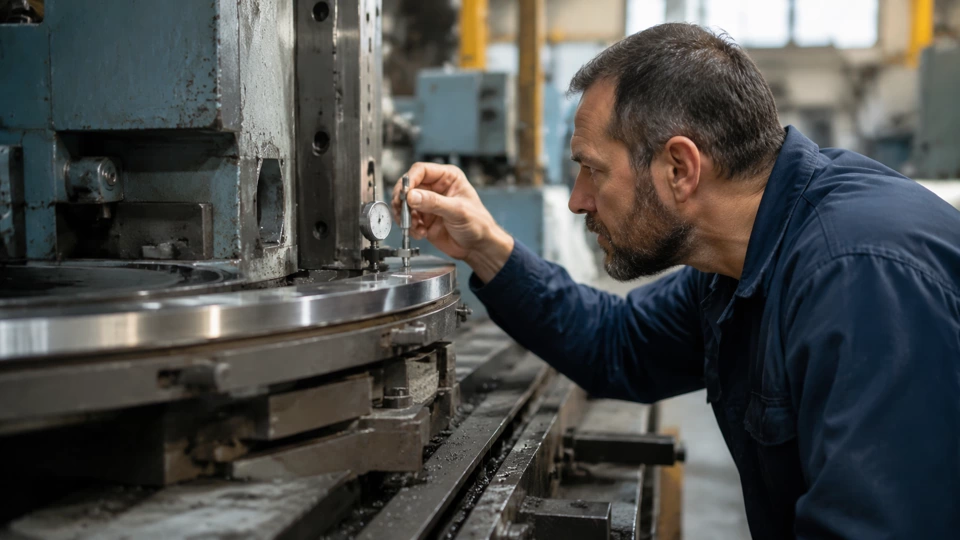
- Check tram with indicator at four corners; note deviation direction.
- Compare current notes to baseline; flag changes over 0.001 inch.
- Use decision tree to choose repair, rebuild, replace, or monitor.
Diagnosing Tram Deviation: Symptom Branches
Identifying the Root Cause from Witness Notes
When I review mill setup tram witness notes, the first branch is symptom-based. If the head is tilted consistently in one axis, the likely cause is a loose or worn drawbar or spindle bearing preload loss. I've seen this in Ohio shops where daily thermal cycles loosen the head lock. If the deviation is random or varies with spindle speed, suspect bearing contamination or a bent quill. Our team logs each setup's tram values and compares them to the baseline. A gradual drift over weeks points to bearing wear, while a sudden shift suggests a crash or loose gib. Documenting these patterns in the machine vise pressure repeatability checklist helps isolate the issue.
For example, a 0.002-inch tilt in the X-axis that reappears after each tool change indicates a spindle bearing issue, not a head alignment problem. We use a test bar and indicator to confirm. If the deviation is less than 0.001 inch and consistent, we move to the monitor branch. If it exceeds 0.003 inch, we escalate to repair or rebuild. The decision tree starts here: symptom type, magnitude, and trend. I always check the that checklist first to rule out workholding influence. That checklist is a critical reference for separating spindle issues from setup errors.
Budget and Downtime: Cost vs. Risk Branch
Weighing Repair Cost Against Production Loss
Once the symptom is identified, the next branch is budget and downtime. For a small shop in Ohio, a full spindle rebuild might cost $8,000 and take three days. Repairing just the bearings could be $2,500 and one day. If the tram error is under 0.002 inch and the job tolerance is ±0.001 inch, we might choose to monitor and adjust setup. I've seen operators compensate with shims, but that adds variability. Our rule: if the repair cost is less than the cost of scrap from one week of production, do the repair. For high-volume runs, even a 0.001-inch error can cause rework. We use the that checklist to ensure workholding isn't masking the problem.
Downtime risk also factors in. If the mill is the only one running a critical job, we might defer the rebuild until a production gap. I recommend ordering replacement bearings in advance to reduce lead time. For a machine with a history of tram drift, we set a monitoring interval of every 50 hours of spindle run time. The decision tree branches: if budget is tight and downtime is critical, choose monitor with frequent checks. If budget allows and downtime can be scheduled, choose repair or rebuild. The that checklist helps us decide if the issue is truly spindle-related or just a setup anomaly.
Confidence Level: Data-Driven Decision Branch
Using Historical Witness Notes to Gauge Certainty
The third branch is confidence level based on data. If we have six months of tram witness notes showing a consistent 0.0015-inch drift, we are confident it's bearing wear and proceed to rebuild. If only two data points exist, we might run a repeatability test: tram the head, run a cut, then re-tram. I always record the results in the that checklist. A confidence score of 80% or higher triggers the replace branch; below 60% we monitor. For example, a sudden 0.004-inch deviation with no prior trend gives low confidence, so we inspect the head lock and gibs first.
We also consider the machine's age and maintenance history. A 10-year-old mill with regular oil changes might have bearing life left. I've seen machines run for years with a 0.001-inch tram error without issue. The decision tree uses a simple matrix: high confidence + high deviation = replace; low confidence + low deviation = monitor. The that checklist provides the data to build confidence. Without it, we are guessing. I always tell operators: trust the notes, not your gut.
Option Tradeoff Table: Repair vs. Rebuild vs. Replace vs. Monitor
Comparing Paths by Key Factors
| Decision signal | Branch | Next move |
|---|---|---|
| Deviation <0.001", consistent, low budget | Monitor | Check tram weekly; update witness notes. |
| Deviation 0.001-0.003", gradual trend | Repair | Replace bearings; re-tram and document. |
| Deviation >0.003", sudden onset | Rebuild | Full spindle rebuild; align head and quill. |
| Deviation >0.005", crash history | Replace | Replace spindle cartridge or entire head. |
This table summarizes the decision signals from our tram witness notes. For each branch, the next move is specific. I've used this approach in Ohio shops to reduce guesswork. The monitor branch requires disciplined record-keeping. The repair branch is cost-effective if caught early. Rebuild is for when the spindle is worn beyond simple bearing swap. Replace is rare but necessary after a crash. Always cross-reference with the that checklist to ensure workholding isn't contributing to the error. That checklist is part of our standard setup procedure.
Implementation: Applying the Decision Tree in Practice
Step-by-Step Field Notes from Our Shop
Here's how we apply the decision tree. First, I pull the tram witness notes from the last month. If I see a pattern, I note the deviation magnitude and axis. For a 0.002-inch Y-axis tilt, I check the head lock and gibs. If they are tight, I move to the budget branch. Our shop rate is $150/hour, so a three-day rebuild costs $3,600 in lost production plus parts. If the job is a tight-tolerance aerospace part, we choose rebuild. If it's a roughing operation, we monitor. I always update the that checklist after each decision to track outcomes.
For example, last month we had a 0.003-inch tram error on a Haas VF-2. The witness notes showed it appeared after a tool change. We chose repair: replaced the spindle bearings in one shift. The cost was $1,200 and downtime was 8 hours. After re-tram, the error was 0.0005 inch. We documented the repair in the that checklist. That checklist now serves as a reference for future decisions. I recommend every shop maintain similar records. The decision tree works because it forces a logical path based on data, not emotion.
Monitoring and Follow-Up: Keeping the Tree Alive
Ongoing Data Collection to Refine Future Decisions
The decision tree is not static. After each repair, rebuild, or replace, we continue collecting tram witness notes. I compare new data to the baseline to see if the fix held. For monitored machines, we set a threshold: if deviation exceeds 0.0015 inch twice in a row, we escalate to repair. This prevents small issues from becoming big ones. In Ohio, where humidity affects machine alignment, we check tram after every 100 hours of operation. The that checklist is updated with each check, creating a history that improves confidence.
I've seen shops skip monitoring and end up with a 0.010-inch error that required a full rebuild. Our approach catches problems early. The decision tree branches are revisited quarterly. If a machine consistently needs repair every six months, we consider replacing the spindle. The that checklist helps identify patterns. For example, if tram drift always occurs after a specific operation, we investigate the workholding. That checklist is our first diagnostic tool. By following this structured approach, we reduce unplanned downtime and maintain part quality.
This article is based on my practical field notes as Carl M. Hendricks, CNC Maintenance Advisor. The information provided is for informational purposes and reflects my experience in Ohio shops. Always consult your machine manual and follow ANSI safety standards when performing maintenance.